Lab-Grown Diamond Engagement Rings: A Practical Guide for Couples
Ferko's Fine Jewelry
Getting engaged may be the romantic part. Choosing the ring is usually where practicality enters the chat. If you are not sure where to start or what actually matters, this guide breaks down everything from stone specs and ring styles to pricing, certification, made-to-order production, and what to expect from Ferko’s in terms of warranty and aftercare.
Why Lab-Grown Diamonds Make Sense for an Engagement Ring
Lab-grown diamonds are physically identical to mined diamonds. Same hardness. Same brilliance. Same optical properties. The difference is origin. A lab-grown stone is created in a controlled environment that replicates the conditions in which natural diamonds form.
For couples looking for an engagement ring, that difference can translate into real advantages. Lab-grown engagement rings often make it easier to go bigger on stone size or invest more in a well-made setting without stretching the budget quite as far. They also appeal to people looking for a conflict free engagement ring or a sustainable engagement ring, especially when sourcing transparency and certification are part of the decision.
Ferko’s offers certified lab-grown engagement rings in a wide range of styles and gold options, combining thoughtful design with the kind of quality, durability, and craftsmanship an engagement ring should have.
Understanding the Stone: Cut, Carat, Color, and Clarity
The 4Cs apply to lab-grown diamonds just as they do to mined stones. If you are choosing a stone for an engagement ring, these are the details that actually matter.
Cut
Cut has the biggest impact on how a diamond looks once it is on the hand. It affects how light moves through the stone, how lively it appears, and how much it sparkles in everyday wear. For an engagement ring, an Excellent, Very Good or Ideal cut grade is usually the right place to start. If you are deciding where to prioritize your budget, do not trade away cut for a little extra carat weight.
Carat
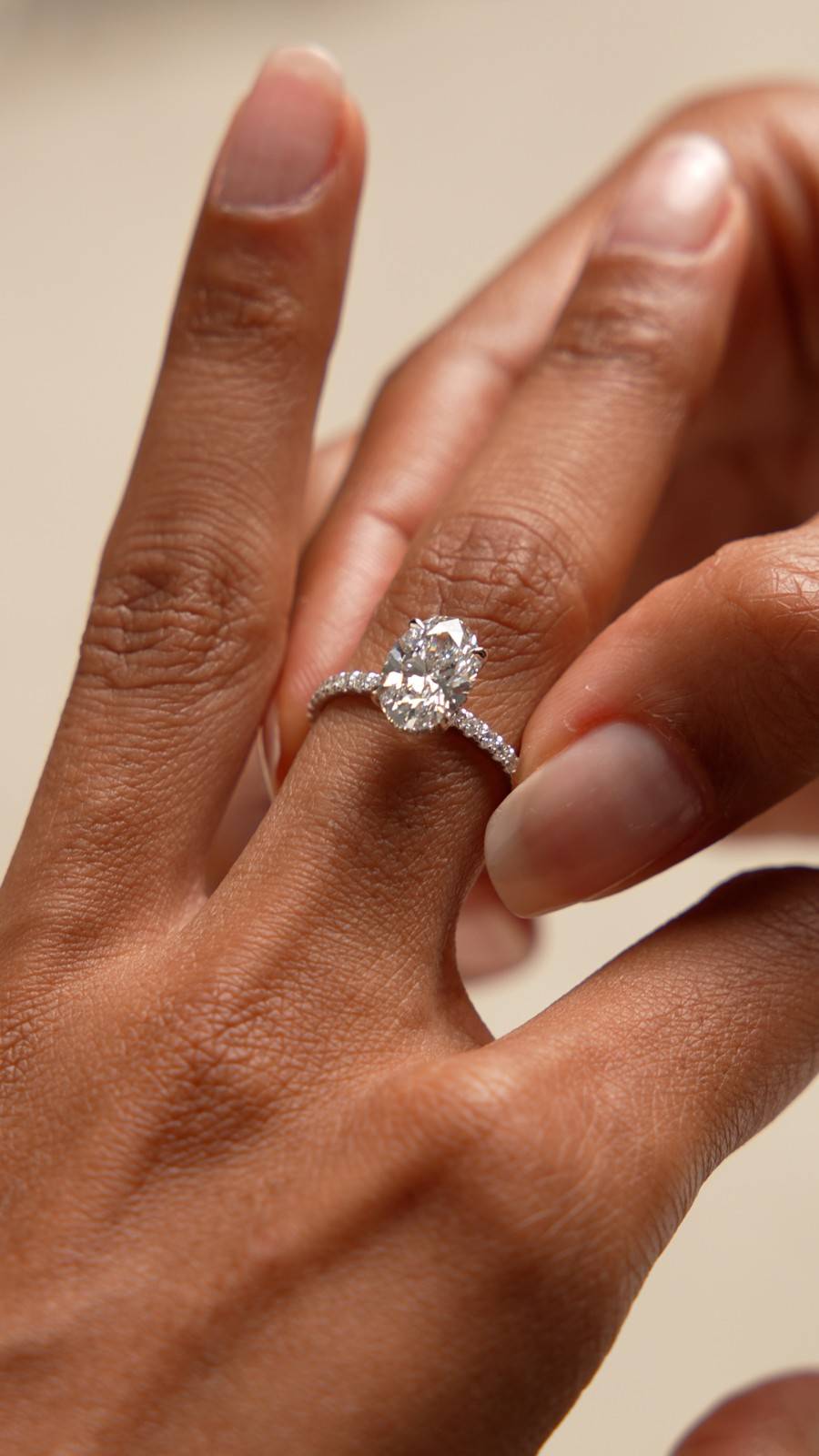
Carat refers to the weight of the stone, not its literal size, though the two are obviously connected. In a solitaire setting, a 1.0 to 1.5 ct round brilliant is a popular range because it offers noticeable presence without pushing the budget too far. Fancy shapes like oval, pear, cushion, and emerald often look larger face-up than a round stone of the same weight, which is worth knowing if you want a strong visual impact for less.
Color
Lab-grown diamonds are graded on the same D-to-Z color scale as mined diamonds. For white gold settings, many couples look at G or higher for a bright white appearance. For yellow or rose gold, you can often go slightly lower without the stone looking obviously warm, since the tone of the gold makes any faint color less noticeable.
Clarity
Most inclusions in a lab-grown diamond are not visible without magnification. That is why VS1 clarity and above is often a comfortable place to start for an engagement ring. You get a stone that looks clean to the eye, while still keeping the focus on factors like cut, which usually make a more visible difference in how the diamond looks.

Certification: What It Means and Why You Should Ask for It
A certification is an independent grading report issued by a gemological laboratory after a detailed assessment of a stone’s cut, color, clarity, and carat weight. It gives you a third-party evaluation of the diamond, so you are not relying on the seller’s description alone.
For lab-grown diamond certification, the two most recognized laboratories are IGI (International Gemological Institute) and GIA (Gemological Institute of America). IGI is especially common in the lab-grown category and provides detailed grading reports that confirm the 4Cs while identifying the stone as lab-grown.
So what does an IGI certificate actually do? It confirms the stone’s graded characteristics, gives you documentation that can be useful for insurance, and makes it easier to compare one diamond with another when you are shopping across retailers. It also brings clarity to a purchase that should not depend on guesswork.
Ferko’s lab-grown diamonds are IGI certified, giving couples independent confirmation of the stone’s quality and characteristics. In a category where details matter, certification is one of the clearest trust signals you can ask for.
Price Guide: What to Expect at Different Budgets
One of the main reasons couples choose lab-grown engagement rings is that the budget tends to go further. And it can give you more flexibility to prioritize stone size, cut, or setting quality without the price escalating as quickly as it often does with mined diamonds.
If your budget is under $3000, it can still open up strong options, especially in solitaire styles. Shape also affects value. Oval, pear, marquise, and emerald cuts often look larger face-up, while round stones usually cost more at the same carat weight. The goal is not just to buy bigger. It is to find the balance of size, shape, and setting that feels right long term.
Budget Range | What It Can Realistically Get You | Best Fit For |
|---|---|---|
Under $1,500 | A classic lab-grown diamond engagement ring in 14k gold, often around 1 ct in a classic solitaire setting | Couples who want a clean, timeless ring and want to stay tightly on budget |
$1,500–$2,500 | A strong sweet spot for lab-grown engagement rings, including 1 to 1.5 ct solitaire styles and some larger elongated shapes | Couples who want noticeable presence without moving into higher-setting costs |
$2,500–$3,500 | Larger center stones, more shape flexibility, and some vintage-inspired or side-stone settings | Shoppers balancing visual impact with design detail |
$3,500 and up | More room for round brilliants at higher carat weights, finer specs, or more elaborate settings | Couples prioritizing size, premium cut, or extra design work |
*Prices updated in April 2026
Durability and Daily Wear
Lab-grown diamond durability Diamonds rank 10 on the Mohs hardness scale, which makes them well suited to daily wear. Still, how well an engagement ring handles everyday life depends not just on the stone, but also on the setting that holds and protects it.
Here are a few practical habits that will help protect your ring and keep it looking its best over time.
- Remove your ring before activities that involve hard impact, like lifting weights, rock climbing, or heavy manual work. A diamond is extremely hard, but a sharp blow can still chip it, especially around the edges.
- Clean your ring regularly with warm water, a small drop of dish soap, and a soft toothbrush. This is especially helpful for prong settings, where oil and buildup tend to collect underneath the stone.
- Have the prongs checked by a jeweler once a year. With daily wear, prongs can loosen over time, and that is usually where trouble starts.
- Store your ring separately from other jewelry. A diamond can scratch softer gemstones and metals if they rub against each other.
- If you work in healthcare, childcare, food service, or another hands-on field, or simply have an active lifestyle, a lower-profile setting can be a more practical choice for everyday wear.
- Brief contact with water, soap, or everyday conditions is usually fine, but prolonged exposure to harsh chemicals is best avoided, especially for the metal and setting.

Warranty, Returns, and Aftercare at Ferko’s
Knowing your purchase is protected matters as much as the ring itself. As Ferko’s here’s what we offer:
Return Policy
We accept returns and exchanges if you contact us within 14 days of delivery and ship the item back within 14 days. Returns requested after this window may be eligible for store credit up to 30 days from delivery. Personalized orders and certain made-to-order styles are not eligible for return or exchange unless the piece arrives damaged or defective.
Warranty
Our jewelry comes with a 6-month warranty unless the item has been damaged. The warranty is also void if the piece has been serviced or altered by a third-party jeweler.
Aftercare and Servicing
We recommend checking your jewelry occasionally for loose prongs or stones and contacting our customer care team if anything feels off. We also offer professional examination and repair services, and in certain cases we provide free stone replacement within 6 months of purchase if there is no damage to the jewelry piece itself. For long-term care, we also recommend repolishing every few years, having prongs checked and stones tightened afterward.
Made-to-Order in the USA
All of our engagement rings are made-to-order in our NYC studio, which means each one is created specifically for you once the order is placed. That matters for a purchase like this. It gives the process a little more intention, and it also means you are not choosing from existing inventory that has been sitting around waiting for the next buyer.
It also gives us more flexibility. Depending on the design, we can offer custom gold color, a range of ring sizes, and in many cases 18K gold or platinum upon request. For couples shopping for a lab-grown diamond engagement ring, that makes made-to-order production feel less like a delay and more like part of getting the ring right.
Our production timeline is typically 7 to 10 business days before shipment, but for many engagement ring styles you should consider an estimated ship window of about 7 to 14 business days. We also offer free standard domestic shipping within the U.S. If you are ordering around a proposal or another specific date, it is best to reach out to us in advance so we can confirm timing.
Questions About Lab-Grown Engagement Rings, Answered
What ring styles work best with lab-grown diamonds for an engagement ring?
Almost any setting style works well for a lab-grown diamond engagement ring. Because lab-grown diamonds have the same optical and physical properties as mined diamonds, they perform just as well in everything from a classic solitaire lab-grown diamond ring to a vintage-inspired halo. The best style usually comes down to your taste, daily routine, and how much detail you want in the setting.
How do I choose the right stone for a lab-grown engagement ring?
Start with cut, because that is what gives a diamond its sparkle. Then look at carat weight in relation to your budget and aim for clarity that looks clean to the eye rather than perfect on paper. And make sure the stone is certified.
What does certification mean, and should I insist on it?
Certification is an independent grading report, usually from IGI or GIA, that confirms a diamond’s cut, color, clarity, and carat weight. Yes, you should insist on it. It is the clearest way to verify what you are buying and compare stones with confidence. At Ferko’s, our lab-grown diamonds are IGI certified, so couples have third-party confirmation of the stone’s quality.
What is made-to-order production and how does it affect quality and customization?
Made-to-order means your ring is created once you place your order, not taken from existing inventory. At Ferko’s, that means your piece is crafted specifically for you in the USA, with mastery from experience. It also allows more flexibility in details like metal choice, stone, and setting.
What are good options for a certified, high-quality lab-grown solitaire ring on a budget?
A solitaire lab-grown diamond ring in 14k gold with a 1 carat center stone is a strong place to start. At Ferko’s, our IGI-certified 1 carat oval and pear lab-grown engagement rings are currently listed at $1,600 and $1,200, which makes them strong budget-friendly options.
*Prices updated in April 2026
Does Ferko's offer custom lab-created engagement rings?
Yes. We offer custom orders for lab-created engagement rings. You can start by sending us an image, reference, or idea, along with any details you have in mind. From there, we provide a personalized quote, secure the order with a deposit, share a 3D CAD rendering for your approval, and craft the piece in approximately 2–4 weeks.
What should I look for when buying a lab-grown engagement ring online in the U.S.?
Look for IGI or GIA certification, clear engagement ring return policy terms, direct customer service access, and transparency around where and how the ring is made. You should be able to verify the basics without guessing. At Ferko’s, our lab-grown diamonds are IGI certified, our styles are handmade to order in our NYC studio, and our policies are clearly laid out, with a customer care team you can reach directly.
What makes a vintage-style lab-created engagement ring affordable without sacrificing quality?
Vintage-style lab-created engagement rings can be more budget-friendly because the lab-grown center stone typically costs less than a mined equivalent, while modern production allows intricate, vintage-inspired details to be crafted with precision. At Ferko’s, that means couples can get the richness of an antique-style look through IGI-certified lab-grown diamonds, made-to-order designs crafted with mastery from experience.
What's a realistic budget for a lab-grown diamond engagement ring?
At Ferko’s, we offer a realistic starting point for a lab-grown diamond engagement ring and it’s around $1,000 for a simple 14k gold style. Many of our 1 to 1.5 carat options currently fall in roughly the $1,200 to $2,000 range, while some 2 carat styles are still available under $2,000 depending on shape and setting. Exact pricing moves with design details and current promotions.
*Prices updated in April 2026
How does made-to-order work, and what can I customize?
With a made-to-order ring, you start by choosing the style, gold color, and size on the product page. Some styles can also be made in larger sizes, 18k gold, or platinum by request. Once the order is placed, we craft the ring in our NYC studio. Our usual production time is 7–14 business days before shipment, with rush timing sometimes possible if arranged in advance.
What does ethical sourcing mean for a lab-grown diamond engagement ring?
For many couples, a conflict free engagement ring starts with choosing a lab-grown stone. Because lab-grown diamonds are created in controlled environments, they can offer a traceable and transparent supply chain. In this context, ethical sourcing usually means clear origin and strong documentation.
How do I care for a lab-grown ring if I have an active lifestyle?
With an active lifestyle, the main thing to protect is not the diamond but the setting. Lab-grown diamond durability is the same as mined, but prongs and gold still take the wear of daily life. To help protect your ring over time, consider taking it off before heavy lifting, impact sports, or working with tools, cleaning it regularly, and having the setting checked once in a while. For extra peace of mind, lower-profile settings like bezels are often a safer choice.
What aftercare and servicing should I expect from Ferko's?
At Ferko’s, we recommend keeping an eye on your ring between wearings, especially for loose prongs or stones. If anything feels off, stop wearing it and contact our customer care team so we can examine it and handle any needed repairs. We also recommend that repolishing or replating every few years can help keep a piece looking its best.
What warranty and return options does Ferko's offer?
We offer a 6-month warranty, provided the piece has not been damaged or altered by a third-party jeweler. For returns, our engagement ring return policy requires customers to contact us within 14 days of delivery, while returns submitted after that may be eligible for store credit up to 30 days in some cases.